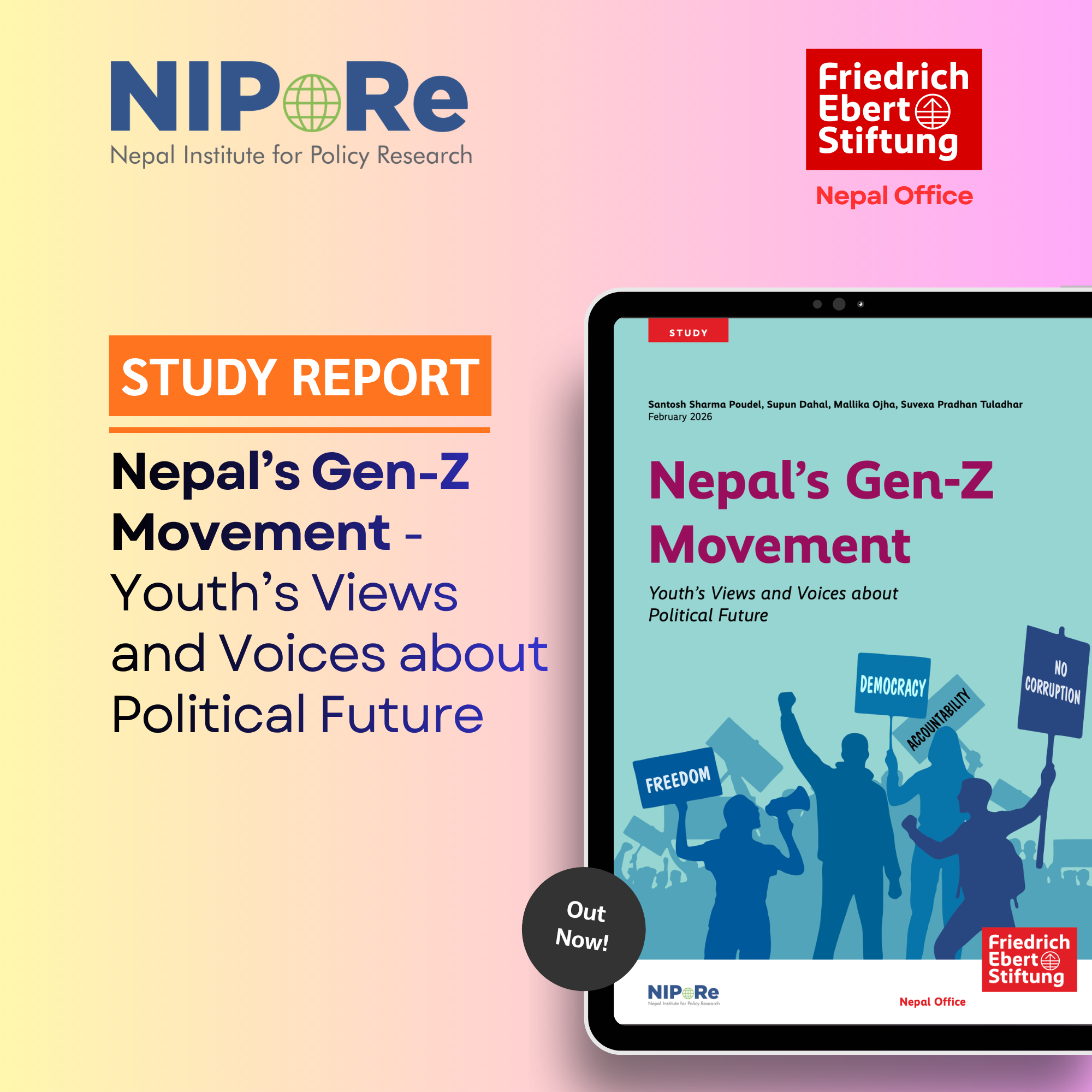
Nepal’s Gen-Z Movement: Youth’s Views and Voices about Political Future examines the September 2025 Gen-Z uprising as a critical moment in Nepal’s contemporary political trajectory, situating it within longer-term patterns of political instability, economic stagnation, and governance failure. The study argues that while triggered by the government’s social media restrictions, the movement reflected deeper structural frustrations, particularly around corruption, lack of economic opportunity, and declining trust in political leadership, shared widely across Nepali society.
Using a mixed-methods approach, the study combines a nationally representative survey of 865 Gen-Z respondents (aged 16–28), focus group discussions across 11 locations, and key informant interviews with political actors, analysts, and youth leaders. This design enables both broad generalisation and deeper qualitative insight into youth perceptions, political behaviour, and expectations.
The findings show that Nepal’s Gen-Z is politically aware, digitally engaged, and increasingly willing to participate in both protest and electoral politics. However, their mobilisation is driven by anti-corruption, accountability, and leadership renewal. While there is deep distrust toward mainstream political parties and leaders, Gen-Z does not reject democracy itself; rather, it calls for its reform and regeneration. The study highlights a key tension: although the movement has generated high expectations for rapid change, the structural nature of governance and economic challenges suggests that meeting these expectations will be far more complex and time-intensive, raising the risk of renewed disillusionment if tangible improvements are not delivered.